

Predictive Analytics
AI Found the Risk.
Did Anyone Call the Patient?
A practical test for determining whether predictive insight is connected to outreach, ownership, and action.
Imagine a patient who has visited the emergency department several times in a short period. A predictive model identifies the pattern, calculates elevated risk, and places the patient on a worklist for follow-up.
The technology worked exactly as intended.
But no specific care team member owns the case. The phone number on file is outdated. The first outreach attempt fails, and there is no clearly defined escalation process. Days pass. Nothing changes for the patient.
The model found the risk. The intervention never began.
Healthcare organizations can identify risk earlier and with greater sophistication than ever before. Predictive analytics can surface patients who may be at increased risk for hospitalization, rising utilization, medication complications, missed care, or worsening chronic conditions.
But patients never experience a risk score. They experience whether someone calls, whether an appointment gets scheduled, whether a barrier gets addressed, and whether the care team follows through.
That distinction matters because predictive insight only becomes valuable when it changes what happens next.
AI Can Work While the Workflow Fails
Healthcare organizations understandably spend significant time evaluating the accuracy of predictive models. Does the model identify the right patients? Does it appropriately stratify risk? Is the signal timely enough to influence care?
Those questions matter. But they do not answer the operational question that comes immediately afterward: what happens once the patient has been identified?
Someone has to receive the signal, understand why the patient was flagged, determine what action is appropriate, initiate outreach, respond when that outreach fails, document the outcome, and communicate what happened to the rest of the care team.
If those responsibilities are unclear, a sophisticated predictive model can ultimately produce little more than a more sophisticated worklist.
A 2025 randomized clinical trial published in JAMA Network Open offers a useful example. Researchers compared interruptive and noninterruptive clinical decision support for patients identified by a statistical model as being at high risk. The interruptive alert was significantly more effective at prompting clinicians to complete in-person risk assessments. The underlying risk identification mattered, but how that information entered the workflow influenced whether someone acted on it.
The lesson extends well beyond one clinical use case. Identifying risk and responding to risk are two different capabilities.
Turn the Risk Signal Into an Action Path
A predictive insight should not end with a score, alert, or worklist. It should begin an operational pathway.
A useful way to examine that pathway is: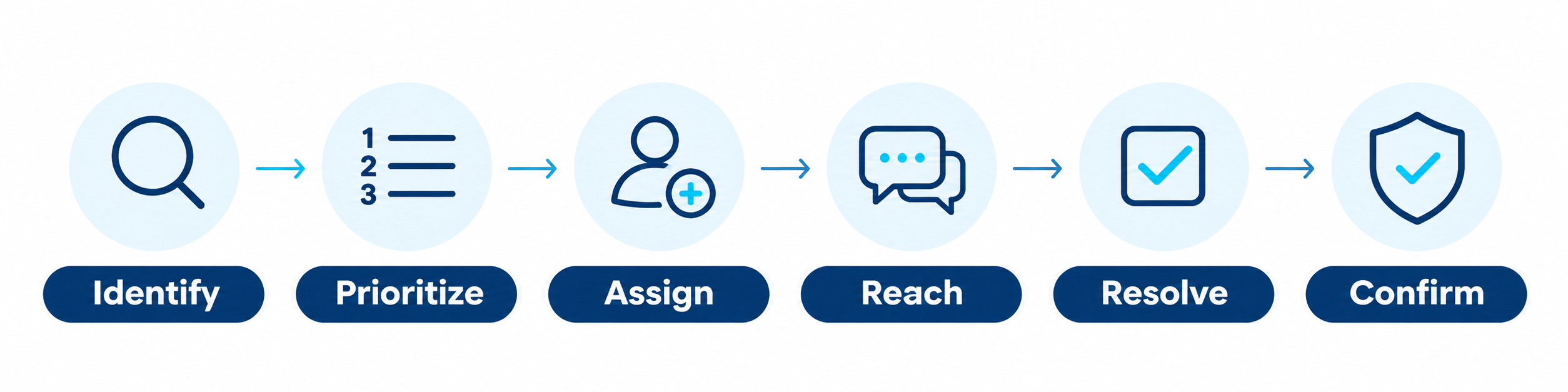
- Identify. The model surfaces a patient who may require attention and provides enough context for the care team to understand why.
- Prioritize. The organization determines the urgency of the risk and the type of intervention that may be appropriate.
- Assign. A specific person or team becomes responsible for reviewing the information and initiating the next action. Ownership cannot be implied.
- Reach. Outreach begins using current contact information and the communication method most appropriate for the patient and situation.
- Resolve. The care team addresses the need behind the signal. That may involve scheduling an appointment, reviewing medications, making a care management referral, arranging transportation, addressing a social barrier, or coordinating another intervention.
- Confirm. The outcome is documented, communicated to the appropriate members of the care team, and monitored until the next step is actually complete.
A failure anywhere in that sequence can prevent an accurate prediction from improving care.
Run the Risk-to-Action Test
Healthcare leaders do not necessarily need another dashboard to determine whether this process is working. One of the simplest tests is to select a patient who was recently identified as high risk and follow that signal from the predictive model all the way to the documented outcome.
Start with five questions.
- Who owned the risk signal? There should be a clearly identifiable person or team responsible for reviewing the information and initiating action.
- What action was expected? Determine whether the care team received a meaningful next step or simply another notification.
- How quickly did the response begin? Measure the time between identifying the risk and making the first meaningful outreach attempt.
- What happened when the patient could not be reached? A failed phone call cannot be the end of the workflow. Look for additional attempts, alternate communication methods, updated contact information, or escalation.
- How was the outcome confirmed? The record should show whether the patient was reached, whether the underlying need was addressed, and whether the appropriate people were informed.
If ownership, timing, escalation, or closure becomes unclear anywhere along that path, the organization has found a more important issue than model performance. It has found the point where insight stops becoming action.
The Risk May Be Clinical. The Barrier May Not Be.
Predictive models often identify risk using clinical and utilization information: chronic conditions, recent emergency care, medication history, missed appointments, or changes in disease status.
But the reason a patient remains at risk may be entirely different.
The patient may not have transportation. A caregiver may be overwhelmed. The patient may not understand the care plan, may be unable to afford a medication, or may not know which provider to call. Contact information may be outdated. An appointment may technically be available but practically inaccessible.
Research on contextualizing care has similarly shown why understanding what is happening around the patient matters. Clinical decision support can help clinicians surface relevant life circumstances and incorporate those factors into care planning, but identifying the context still has to lead to an appropriate response.
That is why outreach cannot be defined as one phone call or one completed task. The care team needs enough context to understand what is preventing the patient from moving forward, coordinate the appropriate response, document what was learned, and confirm that the barrier was actually addressed.
Otherwise, the same patient may continue appearing on a high-risk list while the conditions creating that risk remain unchanged.
Measure What Happens After Identification
Model accuracy is only part of the performance story. Organizations also need to know what happens after the model produces an answer.
That means looking at operational measures such as time from risk identification to first outreach, percentage of identified patients successfully reached, percentage connected to the appropriate service, completion of recommended follow-up, escalation of unresolved needs, and ultimately changes in utilization, quality performance, or patient experience.
These measures reveal whether predictive intelligence has become an organizational capability or remains primarily an analytical output.
The same principle appears in other clinical decision-support research. Algorithmic identification paired with targeted clinician support and outreach can change behavior in some settings, but the model alone is not the intervention. The workflow surrounding the model determines whether information reaches a person who can use it.
For organizations managing value-based care, that distinction is particularly important. The objective is not simply to produce a more advanced prediction. It is to create a connected operating environment in which analytics, care management, provider information, and patient engagement support the same next action.
The Real Test of Healthcare AI
Healthcare AI will continue to become more sophisticated. Models will identify risk sooner, incorporate more information, and generate increasingly precise recommendations.
But better prediction does not automatically create better care.
The most practical question may also be the simplest:
Once AI found the risk, did anyone know what to do next?
Did someone own it? Did someone reach the patient? Did the organization understand the barrier? Did the next action happen? And did anyone confirm that the loop was closed?
That is where predictive intelligence becomes operational intelligence.
AI may find the risk. The organization still has to make sure someone reaches the patient.
References
- Risk Model–Guided Clinical Decision Support for Suicide Screening: A Randomized Clinical Trial. JAMA Network Open, 2025.
https://jamanetwork.com/journals/jamanetworkopen/fullarticle/2828654 - The JAMA Summit Report on Artificial Intelligence. JAMA.
https://jamanetwork.com/journals/jama/fullarticle/2840175 - Additional JAMA Network Open reference supplied by author:
https://jamanetwork.com/journals/jamanetworkopen/fullarticle/2831082

Learn how AaNeel can help empower your members with more connected access to their healthcare information this enrollment season. 👉 www.healthaccesscard.com


