

Healthcare Huddles
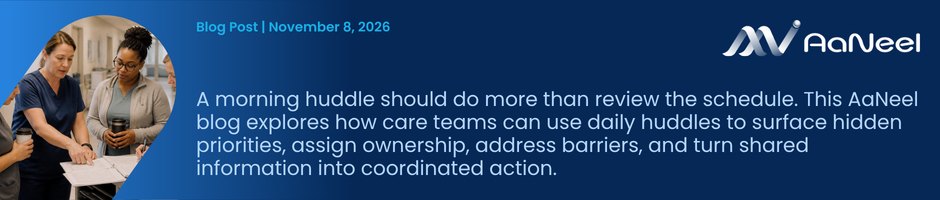
The Morning Huddle
Should Change the Day
A practical test for whether a care team’s daily huddle creates action or only shares updates.
It is 7:45 on a Monday morning. The care team gathers at the nurses’ station, walks through the day’s schedule, flags two patients who will need extra time, and confirms who is covering the front desk. Fifteen minutes later, everyone heads to their rooms and the day begins.
Nobody mentioned the patient who was discharged from the hospital on Saturday. Her medications changed, her specialist follow up was never scheduled, and no one has called her yet. She is not on today’s schedule, so she was not on the agenda.
The huddle happened. The day did not change.
On a football field, every huddle has a job. Players come together for a few seconds to understand what changed, confirm their assignments and agree on the next play, whether the team is driving toward the end zone or recovering from a setback. Healthcare huddles should create the same clarity. In 15 minutes or less, the care team has a chance to review what changed, prepare for the people they expect to see, and bring forward the needs that never appear on a schedule.
The American Medical Association describes the daily huddle as a short standing meeting built around planning the day’s work: reviewing the schedule, spotting scheduling gaps, assessing patient needs and adjusting workflow. A huddle does not need to solve every problem in the room. Its purpose is to prepare the team to act. If the team leaves with the same information and no change in what anyone will do, the huddle was a status update.
What Changed Since Yesterday?
The strongest huddles begin with information that could change today’s priorities. Was a patient admitted or discharged? Did someone visit the emergency department overnight? Is there a new test result, a medication change, an urgent message or a change in someone’s condition? These are the details that should reshape the day before the first patient is roomed.
Unfinished work belongs in the same conversation. An incomplete referral, an unresolved authorization, an unsuccessful outreach attempt or an unanswered patient concern does not disappear because the calendar turned over. The huddle does not need a report of everything that happened. It needs the short list of items that require the team to respond, adjust or follow through.
The Schedule Is Only Part of the Picture
The appointment schedule is the natural starting point, and for patients coming in today it deserves a careful look. Recent care transitions, new clinical information, medication changes, open referrals, chronic care needs and anything that has to be ready before the visit all belong in the review. Practical needs matter just as much. Does someone need an interpreter, or should a caregiver be in the room? Is transportation a concern? Are outside records, lab results or specialist notes available, and does the provider need more time or context?
Then the team has to look past the schedule entirely. The patient discharged on Saturday is the clearest example. She has no appointment today, which makes her invisible on most daily views, yet she may be the person who most needs the team’s attention. The same is true for someone with an urgent result, repeated emergency department visits, an incomplete transition of care or several unsuccessful outreach attempts.
This is where the morning huddle becomes a value-based care tool. The team is preparing for the people who will walk through the door and for the people who need outreach, coordination or follow through before the next encounter happens.
Name the Barrier Before It Becomes a Missed Opportunity
Once a need is on the table, the next question is what could keep the next action from happening. The barrier may be clinical, operational or personal: missing records, a delayed referral, transportation, language needs, caregiver availability, a staffing change, schedule pressure or a workflow no one fully owns. Naming it in the morning gives the team a chance to work around it while there is still time in the day to do so.
Huddles also expose patterns. If outside records are routinely unavailable, referrals regularly stall, or several team members are calling the same patients without knowing about each other’s efforts, the problem is bigger than one patient. A 15-minute huddle will not fix that kind of issue, and it should not try. The pattern should be captured and routed to the operational or quality improvement process that can address it, so the huddle stays focused on today.
Every Priority Needs an Owner
Every priority raised in the huddle should leave with three decisions attached: what needs to happen, who is responsible, and when it will be done or revisited.
Return to the patient discharged on Saturday. The huddle earns its 15 minutes when the medical assistant confirms her medication list, the care coordinator calls her, the referral team verifies the specialist appointment and the provider reviews the discharge summary. Each person knows their part, and her needs are no longer scattered across separate messages, systems and inboxes.
Without ownership, a huddle creates awareness. With ownership, it creates coordinated action.
Run the Healthcare Huddle Test
Healthcare leaders do not need another dashboard to find out whether their huddles are working. Pick one huddle from last week and follow what came out of it.
Start with five questions.
- Did anything change because of it? Look for at least one priority, schedule adjustment or outreach attempt that happened because the team talked, rather than one that was already planned.
- Who was discussed that was not on the schedule? If the answer is no one, recently discharged patients, urgent results and failed outreach attempts are probably waiting somewhere else.
- Did every action leave with an owner and a time? “Someone should call her” is not an assignment. A name and a deadline are.
- What happened to the barriers? Check whether the problems the team raised were solved, escalated or captured for a broader fix, or whether the same barrier came up again the next morning.
- How was the work confirmed? The next huddle should close the loop on yesterday’s actions before it opens new ones.
If those answers are hard to find, the organization has learned something more useful than whether its huddles start on time. It has found the point where shared information stops turning into shared action.
What the Research Shows
Recent studies of clinical huddles put numbers behind what many care teams already sense. A stepped-wedge cluster randomized study published in BMJ Quality & Safety introduced medical safety huddles across four academic hospitals in Toronto. Using blinded chart audits of 912 randomly selected patients, the researchers found a 12 percent lower adjusted rate of adverse events after the huddles began.
Separately, researchers at Florida International University studied nearly 6,800 patient cases in a hospital clinical decision unit. Progression of care huddles cut diagnostic decision time by 14 percent and reduced discharge time by nearly 40 percent for patients who needed complex care coordination, with no increase in 30-day readmissions. That study appears in the Journal of Health Organization and Management.
Both studies come from hospital settings, so their results should not be applied directly to every primary care practice or outpatient clinic. The principles carry over. The FIU researchers found that huddles work best when teams have timely information, clear paths to escalate and resolve issues, and participants with the authority to make decisions. Those same conditions decide whether a clinic’s morning huddle changes the day or simply fills 15 minutes.
The Huddle Is Only as Strong as the Information Behind It
A morning huddle pulls together clinical history, utilization, care gaps, transitions and operational barriers. When that information lives in separate systems and departments, the team spends its few minutes searching instead of planning, and the most important need of the day can stay hidden in a place no one checked. Putting more data in front of the care team will not solve that. Connected visibility will, because it lets the team recognize needs earlier, divide the work clearly and confirm that the next step happened.
Outside records are one of the most common gaps. The Health Access Card® gives care teams secure, patient-authorized access to longitudinal health information at the point of care, so the team is not relying on what a patient remembers or on what another office eventually sends back. It does not replace the EHR, the care team or clinical judgment. It helps the people in the huddle start from a more complete picture.
Technology can organize and connect information, but the people in the circle bring context, clinical judgment and an understanding of the person behind the record. The strongest huddles combine the two, turning visibility into shared awareness, shared awareness into ownership, and ownership into action.
What Will Happen Because the Team Huddled?
Before anyone walks away, one question should have an answer: what will happen today because we had this conversation?
Maybe a provider walks into a visit with information that changes the discussion. Maybe a referral barrier gets cleared before another week goes by, or a care gap is closed during a visit that was already on the books. And maybe, tomorrow morning, the patient discharged on Saturday is the first name on the list, with an owner, a phone call and a follow up appointment attached.
A morning huddle should not add work. It should make clear which work matters most. When the next priority is clear, the owner is named and the team knows what happens next, the huddle has done its job. It has changed the day.
References

Learn how AaNeel can help empower your members with more connected access to their healthcare information this enrollment season. 👉 www.healthaccesscard.com


