Care Decisions

More Data Is Not the Answer.
Clearer Care Decisions Are.
Healthcare does not have a shortage of data. It has a shortage of connected, usable insight at the moment a decision needs to be made.
Claims, encounters, authorizations, lab results, medication histories, care gaps, clinical records, and patient information already exist somewhere across the healthcare ecosystem. Organizations have invested heavily in collecting it, storing it, exchanging it, and making more of it available.
Yet ask a provider, care manager, or patient whether healthcare feels connected, and the answer may tell a very different story.
A provider preparing to diagnose or treat a patient may still need to search across disconnected records to understand what happened before the visit. A care manager responsible for coordinating follow up, closing gaps, and identifying risk may still have to piece together information from multiple sources before determining what requires attention. A patient moving between care settings may still find themselves repeating a history that already exists somewhere else in the healthcare system.
So the question is no longer whether healthcare has enough information. The question is whether that information is helping someone make a clearer decision about what should happen next.
Access Was the First Challenge. Usability Is the Next One.
For years, interoperability has appropriately focused on access. Healthcare information that could not move between systems created obvious barriers to coordination, continuity, and patient engagement. Making that information more available has been essential progress.
But access alone does not solve fragmentation.
A hundred pieces of disconnected information do not automatically create a coherent patient story. A larger dashboard does not necessarily make the next action clearer. More data points do not help a care manager if they still have to determine which ones signal an immediate need and which ones do not.
Information becomes valuable when it creates context. What changed since the patient’s last encounter? Which care gaps remain unresolved? Was the referral completed? Is an authorization still pending? Did the patient fill the new medication? Has utilization changed in a way that suggests rising risk? Is there something happening now that someone on the care team needs to address?
These are not abstract data questions. They are care questions.
The technology matters because it should make those answers easier to find.
What Recent Federal Action Is Telling Us
Several current federal initiatives reinforce the importance of reducing administrative friction and making healthcare information easier to understand and act on.
In May 2026, the Departments of Health and Human Services, Labor, and Treasury, along with the Office of Personnel Management, finalized changes to the No Surprises Act Federal Independent Dispute Resolution process. The reforms are specifically focused on payment disputes, but the operational problems they address will sound familiar throughout healthcare: inconsistent information, complicated communication, unclear status, unnecessary administrative work, and difficulty understanding what happens next.
The final rule strengthens information exchange between payers and providers, modifies dispute processes and timelines, and significantly reduces the administrative fee for new disputes. CMS is also transitioning the Federal IDR process from individual web forms to a centralized IDR Gateway, giving participating organizations a single environment in which to initiate disputes, monitor status, review activity, and manage the process.
Learn more about the Federal IDR Operations Final Rule from CMS.
A payment dispute process is not the same thing as care management, but the underlying operational lesson is relevant. Complexity multiplies when information is delayed, inconsistent, difficult to interpret, or scattered across multiple processes. Making information easier to access and understand can reduce the effort required simply to determine status, responsibility, and next steps.
The same principle applies when the subject is not a payment dispute, but a person who needs care.
CMS 0057 F Moves the Conversation Closer to Care
The connection becomes even clearer with the CMS Interoperability and Prior Authorization Final Rule, CMS 0057 F.
The rule is designed to improve the electronic exchange of healthcare information and reduce burden associated with prior authorization. Certain operational requirements took effect beginning in 2026, including requirements around prior authorization decision timeframes, specific denial reasons, and publicly reported prior authorization metrics. Additional API requirements, generally beginning in 2027, expand how impacted payers exchange information with patients, providers, and other payers.
Read the CMS Interoperability and Prior Authorization Final Rule overview.
Those requirements matter because they move healthcare beyond the basic idea that information should be exchangeable. They begin to connect interoperability with actual workflows.
For example, CMS requires impacted payers to implement a Provider Access API that can make specified claims, encounter, clinical, and prior authorization information available to in network providers who have a treatment relationship with a patient. The Prior Authorization API is designed to communicate documentation requirements and support electronic prior authorization requests and responses, including whether a request was approved, denied, or requires additional information.
That is an important evolution. The objective is not simply to move another data file from one organization to another. It is to make information available in ways that can better support what patients, providers, and care teams are actually trying to accomplish.
Care Management Depends on Context
This distinction is especially important in care management because care coordination is fundamentally an exercise in understanding context.
A single claim rarely tells the full story. Neither does a lab result, an encounter record, an authorization, or a care gap viewed in isolation. Effective care management depends on understanding how those pieces fit together across conditions, settings, providers, and time.
A care manager may need to know that a patient was recently discharged, missed a follow up appointment, has an open care gap, received a new prescription, and has a pending authorization. Individually, each piece of information provides some value. Together, they begin to reveal a patient who may need intervention.
That is the difference between data availability and actionable insight.
The goal should not be to place every available piece of information in front of a provider or care manager. Healthcare professionals already operate in an environment of alerts, notifications, documentation requirements, inboxes, dashboards, and competing demands.
The better goal is to help surface what matters, when it matters, and why it deserves attention.
For a provider, that could mean seeing the most relevant parts of the patient’s history before making a clinical decision. For a care manager, it could mean identifying which individuals require outreach today rather than manually searching several systems to build a priority list. For an operational team, it could mean understanding where authorizations, referrals, or transitions are becoming stuck before the problem reaches the patient.
The value is not in seeing everything. The value is in seeing enough of the right information to understand the next step.
The Patient Should Not Be the Integration Layer
Patients experience the consequences of disconnected information differently, but perhaps more personally.
When systems fail to communicate, the patient often becomes the person responsible for filling in the gaps. They repeat medication lists, explain previous diagnoses, recall the name of a specialist, describe a procedure completed months earlier, or try to remember whether an authorization was approved.
In other words, the patient becomes the integration layer between organizations that already possess pieces of the same healthcare story.
That is not what interoperability should look like from the patient’s perspective.
Connected healthcare should reduce the amount of reconstruction required every time someone moves from one provider, setting, or organization to another. The patient should be able to participate in the conversation, correct information, ask questions, and make decisions without carrying the entire burden of connecting the system themselves.
Making data move is important. Making the patient experience feel connected is the larger objective.
What This Means for Justin
Imagine Justin has seen his primary care physician, visited a specialist, completed diagnostic testing, changed a medication, and is now waiting for the next step in his treatment.
There is plenty of data about Justin.
The primary care practice has information. The specialist has information. His payer has claims and authorization information. His pharmacy has prescription information. Other clinical systems may hold additional pieces of his history.
The problem is not that Justin’s healthcare journey generated too little data. The problem occurs when the person making the next decision cannot see enough of that journey to understand what has already happened and what still needs to happen.
Justin should not need to arrive at his next appointment prepared to reconstruct the story himself. His care manager should not have to search across several disconnected systems to discover that follow up was never completed. His physician should not have to make a decision without relevant information that already exists somewhere in the healthcare ecosystem.
When connected information creates context, the experience changes. The provider can make a more informed decision. The care manager can see where attention is needed. Justin can participate in his care without serving as the messenger between systems.
That is when interoperability begins to feel like better healthcare instead of better technology.
From Interoperability to Intelligent Action
Healthcare has made enormous progress in recognizing that information needs to move. The next opportunity is making sure that movement creates something useful on the other side.
This requires organizations to think beyond technical connectivity and ask practical questions about how data supports actual workflows. Can providers see the information they need without searching through unnecessary detail? Can care managers recognize changes in risk and prioritize the right outreach? Can authorization status become part of the workflow rather than another portal to check? Can patients and caregivers understand what has happened and what comes next?
Interoperability should remove friction, not simply relocate it.
This is where connected care management becomes particularly powerful. When clinical, administrative, payer, and patient information can be brought into better context, organizations have the opportunity to move from retrospective reporting toward more timely action.
Providers gain a clearer picture before care is delivered. Care teams can identify risk, prioritize outreach, and coordinate interventions more effectively. Patients experience fewer disconnected handoffs and have a better chance of moving through the system without repeatedly rebuilding their own healthcare history.
The result is not simply more information on a screen. It is a healthcare environment in which information can support a decision, a conversation, an intervention, or a next step.
The Measure of Progress Is What Happens Next
Healthcare transparency has sometimes been discussed as though making information visible is itself the destination. Visibility matters, but it is only one part of the journey.
Real progress happens when information makes healthcare easier to understand, easier to coordinate, and easier to act on.
As healthcare moves toward more digital, connected, and accountable models, organizations will increasingly need to look beyond whether they have technically satisfied an interoperability requirement. They will need to evaluate whether connected information is helping the people who deliver, coordinate, and receive care.
That means designing around real workflows. It means reducing unnecessary searching and reconstruction. It means helping the right information reach the right person at the right moment. Most importantly, it means remembering that interoperability is not ultimately about the movement of data. It is about what people can do because that data moved.
Better care does not happen when more data simply arrives. It happens when providers, care managers, and patients have enough clarity to understand what should happen next.
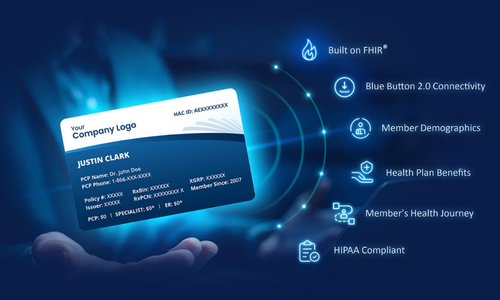
Learn how AaNeel can help empower your members with more connected access to their healthcare information this enrollment season. 👉 www.healthaccesscard.com