Open Enrollment

It’s Open Enrollment.
Do Your Members Have Access to Their Own Data?
Medicare Open Enrollment begins October 15, giving millions of people the opportunity to evaluate whether their current health and prescription drug coverage will continue to meet their needs in the year ahead. But how informed can that decision really be if members cannot easily access the information they need to understand their own healthcare?
CMS encourages people with Medicare to review their coverage every year because plan costs, benefits, provider networks, and pharmacy networks can change. Medicare Open Enrollment runs from October 15 through December 7, and members can use that period to change Medicare health plans and prescription drug coverage for the following year. Learn more about Medicare Open Enrollment from CMS.
Choosing coverage, however, is about more than comparing premiums and benefits.
Members are also trying to understand their own healthcare experience. Which providers have they seen? What medications are they taking? What services have they used? How has their care changed throughout the year? What information will be available if their coverage or providers change?
That information exists throughout the healthcare ecosystem, but accessing it can still require navigating multiple portals, applications, documents, and disconnected systems.
Open Enrollment puts a spotlight on a much larger issue in healthcare: member choice depends on member access.
Better Choices Require Better Information
Healthcare consumers are being asked to take a more active role in choosing and managing their coverage, yet the information needed to make those decisions has not always been equally easy to access.
A member may remember the name of a primary care physician but not every specialist involved in their care. They may know which prescriptions they take but not have a complete picture of their claims, utilization, or coverage history. A caregiver helping a parent choose coverage may be trying to reconstruct an even more complicated healthcare journey.
That makes enrollment more than a comparison of plan options. Members are making decisions based on their personal healthcare experience, and the more complete that picture is, the better equipped they are to understand what they may need next.
Interoperability can help make that possible by allowing healthcare information to move more effectively across systems and giving individuals greater ability to access and use their own information.
CMS’s Blue Button API demonstrates that direction. It gives people with Medicare the ability to authorize applications to access Medicare claims information and uses the HL7 FHIR standard for data exchange. Blue Button is also based on the CARIN Consumer Directed Payer Data Exchange Implementation Guide. Explore the CMS Blue Button API.
The technology behind that exchange matters, but the principle matters even more: healthcare information should be available to the person whose care it represents.
Transparency Does Not End With a Benefits Document
For health plans, Open Enrollment naturally brings increased attention to benefits, premiums, provider networks, pharmacy coverage, and other plan features. Those are critical pieces of transparency, but today’s members increasingly need something more.
They need ongoing visibility into their own healthcare information after enrollment is complete.
Transparency matters most when members can understand not only what their plan offers, but also how their coverage and health information connect throughout the year. Claims, clinical information, medications, provider activity, and prior authorization information can all contribute to a more complete view of the member’s healthcare experience.
CMS’s interoperability initiatives are continuing to move healthcare in this direction. Through the Patient Access API, impacted payers make certain claims, encounter, clinical, and coverage information available so members can access that information through applications of their choice. CMS has also established additional interoperability requirements that expand the information available through these APIs. Read more about the CMS Patient Access API.
For health plans, data access can become part of the member experience rather than simply a regulatory requirement.
A member who can more easily access and understand their information may be better equipped to navigate care, communicate with providers, and understand the value their plan is helping deliver. Transparency can help strengthen trust because members are no longer simply being told that their information is available. They can actually use it.
From Data Availability to Data Usability
Making data technically available is an important milestone, but it is not the finish line.
A member should not need to understand APIs, FHIR resources, interoperability architecture, or data exchange standards to benefit from the work happening behind the scenes. The real measure of progress is whether members can get to their information, understand it, and use it when they need it.
This is where standards such as CARIN become important.
CMS identifies the CARIN Consumer Directed Payer Data Exchange Implementation Guide, also known as CARIN for Blue Button®, among the implementation guides supporting the Patient Access API. These standards help establish a common approach for exchanging payer information through FHIR based APIs rather than requiring every organization to create its own method of consumer access. See CMS interoperability standards and implementation guides.
Standards create the foundation.
The member experience determines whether that foundation delivers value.
What This Means for Justin
Imagine Justin sitting at his kitchen table during Medicare Open Enrollment. He has his plan materials nearby, several prescription bottles, and a list of providers he has seen during the year.
Over the past twelve months, he has visited his primary care physician and several specialists, completed diagnostic testing, filled prescriptions, and had changes made to his care plan. Now he is being asked to determine whether his existing coverage still meets his needs for the year ahead.
Justin should not have to reconstruct an entire year of healthcare from memory to make that decision.
His own healthcare information should be part of the conversation.
When Justin can access his claims, coverage, and health information in a way that is understandable and portable, he has a clearer picture of the care he actually uses. He can ask better questions, have more informed conversations with his family or providers, and evaluate his healthcare choices with greater confidence.
That is what interoperability should ultimately accomplish. It is not simply about moving information between systems. It is about putting useful information closer to the person whose health it represents.
Making Member Access More Practical
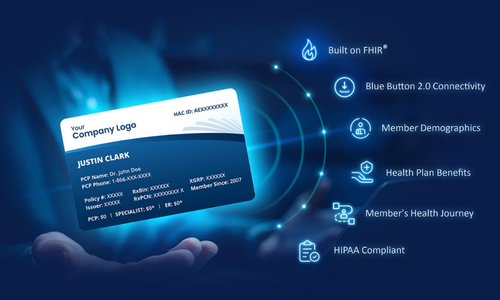
For health plans, this creates an opportunity to rethink what member access looks like in a more connected healthcare environment. Traditionally, an insurance identification card answers a fairly simple question: who is this member, and what coverage do they have? Today, that familiar point of access can become much more useful by helping connect coverage information with the broader health information members may need throughout their care journey.
AaNeel’s Health Access Card® is designed around that opportunity. It modernizes the traditional physical insurance ID into a secure, digital first health access solution built on FHIR and CMS Blue Button standards. Using the Health Access Card and a secure PIN, members can access and share their health information when needed, helping create a more connected experience across providers, settings, and transitions in care.
The goal is not to give members another complicated portal or application to manage. It is to make insurance and health information easier to access, easier to use, and more connected to the moments when members actually need it. For someone like Justin, that could mean having important information available when visiting a new specialist, traveling, reviewing recent care, or simply trying to better understand his own health history.
For the health plan, this also creates an opportunity to make interoperability visible in a way members can actually experience. Instead of data access remaining something that happens behind the scenes, it becomes part of the plan’s member experience and a practical way to support transparency, engagement, and continuity of care.
Open Enrollment Is the Beginning, Not the End
Medicare Open Enrollment creates a natural moment for members to think carefully about their healthcare choices, but the need for access and transparency does not disappear on December 7. Members need information throughout the year when they schedule care, visit a new physician, manage a chronic condition, change providers, help a family member, travel, or face an unexpected health event.
The strongest member experience is not built around one enrollment decision. It is built around access throughout the healthcare journey. That is why interoperability matters during Open Enrollment and long after it ends. The ability to access healthcare information gives members something a benefits comparison alone cannot provide: a clearer view of their own healthcare experience and a better understanding of the care they actually use.
As healthcare becomes increasingly connected, health plans have an opportunity to think beyond whether member data is technically available. The more meaningful question is whether members can actually find it, understand it, and use it when they need it. That shift turns interoperability from a backend requirement into a visible part of the member experience.
This Open Enrollment season, plans can move beyond simply providing information about coverage and toward giving members greater access to the information that helps them understand and navigate their health. For organizations focused on transparency, engagement, and long term member trust, that access can become an important part of how the plan demonstrates value throughout the year.
Learn how AaNeel can help empower your members with more connected access to their healthcare information this enrollment season. 👉 www.healthaccesscard.com