AHIP 2026

5 Takeaways from AHIP 2026:
What Health Plans Are Thinking About Next
By Kelly Hidde
The AHIP 2026 booths have been dismantled. The Summer Bash is over. The beach balls have been packed away. Thousands of healthcare leaders have returned home from Las Vegas and are back to tackling the realities of healthcare transformation.
That is usually how conferences end.
What makes AHIP valuable, however, is not what happens during the conference itself. The real value comes from the conversations that continue after everyone returns home and begins translating ideas into action.
Throughout AHIP 2026, the AaNeel team had the opportunity to meet with health plan executives, interoperability leaders, care management professionals, innovation teams, digital health strategists, and member experience leaders from across the country. While each organization faces its own unique challenges, many of those conversations ultimately pointed toward a handful of larger industry trends that are shaping the future of healthcare.
Here are five observations that surfaced repeatedly throughout the week.
1) Healthcare Doesn’t Have a Data Problem. It Has an Access Problem.
For years, healthcare has focused on generating, collecting, storing, and exchanging information. Today, most organizations have access to more data than ever before. Claims data, clinical records, pharmacy information, quality measures, social determinants of health, care management documentation, and patient-generated data all contribute to an increasingly complete picture of patient health.
Yet despite this abundance of information, many organizations continue to face remarkably similar challenges. Care teams spend valuable time searching for information that exists somewhere else. Providers often work without a complete view of a patient’s history. Members frequently find themselves acting as the bridge between disconnected systems, repeating information and carrying records from one organization to another.
The conversations at AHIP suggested that healthcare’s next challenge is not collecting more information. The challenge is ensuring that existing information becomes more accessible, more connected, and more actionable for the people who need it most. Organizations are increasingly recognizing that the value of data is not determined by how much exists, but by how effectively it can be used to support decisions, coordination, and outcomes.
2) Interoperability Is Finally Moving Beyond Compliance
A few years ago, interoperability discussions were dominated by regulatory mandates, compliance deadlines, technical standards, and implementation requirements. Those conversations remain important, but they no longer appear to be driving the industry’s attention in the same way.
Instead, organizations are asking more practical and strategic questions. What becomes possible when information moves more effectively? How does interoperability improve member engagement? How can connected information support earlier interventions, reduce administrative burden, and strengthen care coordination?
The conversation has matured because healthcare leaders increasingly understand that interoperability is not the objective. Interoperability is the infrastructure that enables better experiences, better decisions, and better outcomes.
The focus is shifting away from technology for technology’s sake and toward measurable operational impact. That shift may be one of the most encouraging developments currently taking place across the healthcare landscape.
3) Member Experience Is Becoming a Strategic Priority
One of the strongest messages emerging from AHIP was the growing connection between member experience and organizational performance. Historically, member experience was often viewed as a supporting function. Today, it is increasingly being viewed as a strategic capability that directly influences engagement, satisfaction, retention, and outcomes.
Health plans are recognizing that administrative experiences and healthcare experiences are often inseparable in the minds of members. When information is difficult to access, benefits are difficult to understand, or services are difficult to coordinate, those challenges create friction that can influence everything from preventive care participation to medication adherence.
Conversely, when organizations make healthcare easier to navigate, they create opportunities for stronger engagement and more proactive healthcare decisions. As healthcare continues to evolve toward more consumer-focused models, member experience is becoming far more than a customer service initiative. It is becoming a core component of healthcare delivery itself.
4) The Insurance Card May Be Due for a New Purpose
One of the more interesting conversations throughout AHIP centered around a tool that every healthcare consumer already carries: the insurance card.
For decades, insurance cards have served a straightforward purpose. They identify coverage, provide member information, and help facilitate access to healthcare services. While healthcare has undergone tremendous transformation over the last several decades, the role of the insurance card has remained largely unchanged.
At the same time, expectations around healthcare information have changed dramatically.
Consumers increasingly expect information to be accessible when and where they need it. They manage banking, travel, shopping, communication, and countless other aspects of their lives through digital tools that provide immediate access to information. Healthcare is moving in the same direction.
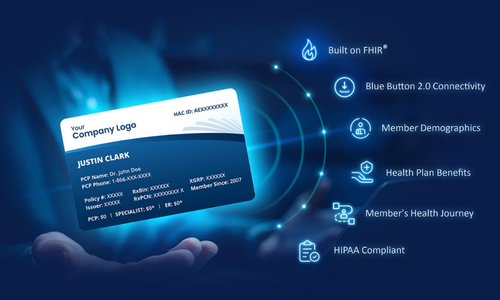
That is one of the reasons the Health Access Card® generated so many conversations during AHIP. The concept is simple but powerful: what if a familiar tool could play a larger role in helping members securely access and share their healthcare information?
The conversations were never really about a card. They were about a broader shift taking place across healthcare. Organizations are increasingly recognizing that members need to become more active participants in the healthcare information ecosystem. The easier it becomes for individuals to access and share their information, the easier it becomes to support care coordination, improve engagement, and create a more connected healthcare experience.
5) The Organizations That Win Will Be the Ones That Reduce Friction
If there was one observation that seemed to connect nearly every conversation at AHIP, it was the recognition that healthcare remains too difficult to navigate.
Patients struggle to access information. Providers spend time searching for records. Care teams work across disconnected systems. Health plans continue looking for ways to simplify experiences while improving outcomes. Regardless of the specific challenge being discussed, the underlying issue often came back to complexity.
The organizations that succeed over the next decade will not necessarily be the organizations with the most data, the most technology, or the largest budgets. They will be the organizations that do the best job of reducing friction across the healthcare journey. Whether that friction exists in accessing information, coordinating care, understanding benefits, managing transitions, or engaging members, removing unnecessary complexity creates opportunities for better experiences and better outcomes.
Healthcare leaders increasingly understand that innovation is not always about adding something new. In many cases, it is about making existing processes simpler, faster, and easier for the people who rely on them.
Looking Ahead
One of the most valuable aspects of AHIP is that it provides a glimpse into where healthcare leaders are directing their attention. This year’s conversations consistently pointed toward accessibility, connectivity, usability, and member empowerment. While the specific technologies and solutions will continue to evolve, the broader direction appears increasingly clear.
Healthcare organizations are looking for ways to make information easier to access, care easier to coordinate, and healthcare experiences easier to navigate. They are focusing less on technology as an end goal and more on how technology can support better outcomes, stronger engagement, and more informed decision-making.
We are grateful to everyone who stopped by Booth 1301, joined us at the Summer Bash, participated in the Lemon Challenge, and shared their perspectives throughout the week. Those conversations reinforced something we have long believed: the future of healthcare is not about generating more data. It is about making the data we already have more accessible, actionable, and useful.
The organizations that succeed over the next decade will be the ones that make healthcare information work better for the people who need it most.