Real-Time Healthcare Data and Value-Based Care
Real-Time Data Is Becoming the Infrastructure of Value-Based Care
Why the Federal Focus on Timely Health Information Signals a Turning Point for Healthcare
For years, healthcare leaders have talked about value-based care primarily in terms of reimbursement. New payment models shifted financial accountability toward outcomes, quality, utilization, and total cost of care, asking organizations to manage populations differently than they did under traditional fee-for-service medicine.
But reimbursement was only one part of the transformation. As federal healthcare priorities increasingly emphasize interoperability, digital quality measurement, administrative simplification, transparency, and more timely access to health information, another requirement is becoming difficult to ignore: value-based care cannot operate effectively on yesterday’s information.
That is an important distinction. Organizations can accept financial accountability through a value-based contract, but if their underlying information infrastructure still operates according to the fragmented, retrospective workflows of fee-for-service healthcare, their ability to manage that accountability will always be constrained.
Recent federal attention to improving outcomes, reducing administrative burden, and expanding the use of real-time data reinforces a direction that has been developing across healthcare policy for several years. The question for healthcare organizations is increasingly shifting from whether they participate in value-based care to whether their infrastructure is capable of supporting it.
The Economics Changed Faster Than the Infrastructure
Many healthcare organizations are effectively operating two different models at once. Their reimbursement structures increasingly reward coordination, prevention, quality, and longitudinal management, while much of the information needed to accomplish those goals remains fragmented across health plans, hospitals, physician practices, specialists, pharmacies, laboratories, and other care settings.
That disconnect creates more than inconvenience. An ACO may be financially accountable for what happens to a patient across the continuum, even when no single participant in that continuum has a complete, timely view of the patient’s journey. A health plan may have extensive claims history but lack immediate clinical context. A physician may understand what happened during today’s encounter but have limited visibility into what occurred somewhere else last week.
We have increasingly asked healthcare organizations to manage the whole patient while continuing to give them fragments of the patient’s story.
That becomes especially consequential as accountability expands across Medicare Advantage, Medicaid, ACOs, and other value-based models. Managing utilization, identifying emerging risk, closing care gaps, and coordinating interventions all depend on understanding what is happening across time and across settings. When that information arrives weeks or months later, organizations are not truly managing care in real time. They are managing its aftermath.
Timing Changes the Value of Data
Healthcare does not have a shortage of data. The more difficult problem is making the right information available when someone can still do something with it.
Consider a care gap identified several months after an encounter. The information may still be accurate, but its clinical and operational value has diminished. A hospitalization discovered after discharge may eventually inform risk stratification, but it cannot help a care manager coordinate the transition home when the patient actually needs support.
The same principle applies to changes in medications, laboratory results, specialist encounters, emergency department visits, and other events across the patient journey. The value of information is inseparable from its timing.
More timely access to longitudinal information gives organizations a better opportunity to identify changing patterns, understand patient complexity, and align interventions with emerging needs. Rather than reconstructing the patient’s journey retrospectively, care teams can begin responding while that journey is still unfolding. For value-based organizations, that difference can affect far more than workflow efficiency. It can influence utilization, quality performance, patient experience, and ultimately financial sustainability.
Quality Is Becoming More Continuous, Too
The evolution of quality measurement adds another dimension to the conversation. Healthcare has traditionally relied heavily on retrospective measurement. Performance is collected, reconciled, reported, and analyzed after much of the measurement period has already occurred. That model can tell an organization how it performed, but it leaves considerably less opportunity to change the outcome.
The growing emphasis on digital quality measures and patient-reported outcomes points toward a more continuous model. As organizations gain earlier access to relevant information, quality management has the potential to become less about documenting what happened and more about influencing what happens next.
For ACOs and other organizations carrying performance accountability, this matters. Insight delivered earlier in the performance cycle creates more time to act. Care gaps can be addressed sooner, outreach can become more targeted, and interventions can be adjusted before the measurement window closes rather than explained after the fact.
That is not simply better reporting. It represents a fundamentally different way of managing performance.
Administrative Burden and Data Fragmentation Are the Same Conversation
Reducing administrative burden and improving interoperability are often discussed as separate healthcare priorities. Operationally, they are deeply connected.
Many of healthcare’s manual processes exist precisely because information does not move efficiently between the people and organizations that need it. Staff members make phone calls, send faxes, request records, reconcile documents, reenter information, and ask patients to repeat histories because the underlying systems cannot reliably exchange the information themselves.
The administrative burden is therefore not always the problem. In many cases, it is the symptom of a disconnected information environment.
As interoperability capabilities mature, the opportunity is not merely to digitize those manual processes. It is to reconsider why they are necessary in the first place. When relevant clinical context can follow the patient across settings, providers spend less time reconstructing what happened elsewhere, care managers gain better visibility into emerging needs, and health plans and provider organizations can coordinate around a more complete understanding of the patient.
The goal is not technology for technology’s sake. It is removing the friction created when healthcare information cannot keep pace with healthcare delivery.
Real-Time Data Still Has a Human Purpose
There is a risk in conversations about interoperability, APIs, digital quality measures, and real-time data that healthcare begins to sound like an infrastructure project. It is worth remembering what all of that infrastructure is supposed to accomplish.
Every record represents a person moving through a healthcare system that can be extraordinarily difficult to navigate. That person may be managing several chronic conditions, seeing multiple specialists, taking numerous medications, caring for a spouse, working full time, or trying to understand what happened during a recent hospitalization.
When information is fragmented, the burden of connecting it often falls back on that individual. Patients repeat medical histories, carry medication lists, try to remember which physician ordered which test, and wonder whether one office ever received the results from another. Too often, the patient becomes the connective tissue between systems that were never designed to communicate effectively.
Connected information changes more than the efficiency of healthcare. It changes the experience of receiving care.
When patients can access their own information and providers can see a more complete longitudinal history, conversations can begin with greater context. Decisions can be made with better information, and patients can participate more meaningfully in their care because the information surrounding that care is more accessible to them.
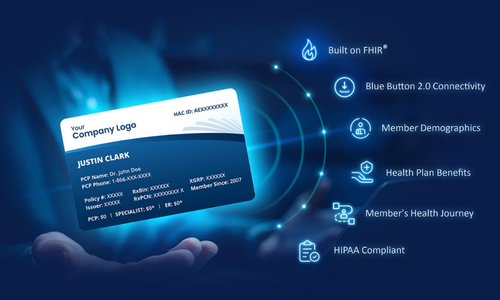
 What This Means for “Justin”
For Justin, none of this is really about real-time data.
He is not thinking about interoperability standards when he walks into his cardiologist’s office, and he probably does not care which API allowed information to move between two healthcare organizations. What matters to him is whether his cardiologist knows about the medication his primary care physician recently changed, whether his care manager knows he was just discharged from the hospital, and whether he has to reconstruct his medical history from memory every time he encounters a new provider.
We introduced Justin in our patient perspective on connected care because he represents millions of people navigating multiple conditions, medications, specialists, and healthcare settings. For patients like Justin, the difference between retrospective and real-time information can be the difference between healthcare that reacts to what already happened and care that has an opportunity to respond to what is happening now.
That is the human value behind the federal push toward more timely information. Better infrastructure should ultimately mean that Justin spends less time carrying information between healthcare organizations and more time participating in decisions about his own health.
Operational Readiness Is Becoming Strategic Readiness
The continued federal emphasis on real-time information should therefore be viewed as more than another technology requirement or compliance exercise. It signals a broader change in what healthcare infrastructure is expected to accomplish.
Organizations preparing for that environment should be asking harder questions. How quickly can information move across their ecosystem? How complete is the longitudinal view available to clinicians and care teams? Can data be used while there is still time to influence an outcome? Can patients access and authorize the sharing of their own health information? How much administrative work exists simply because information cannot move efficiently?
Those are technology questions, but they are also increasingly clinical, operational, and financial questions.
At AaNeel, we believe interoperability becomes valuable when it moves beyond the exchange of information and begins supporting the decisions that surround a patient. That means connecting data across the healthcare journey, making information accessible when it is needed, and helping organizations turn fragmented records into a more complete and actionable understanding of the people they serve.
Value-based care changed who is accountable for outcomes. The next phase is building the infrastructure that allows organizations to act on that accountability.
Real-time data will not create better healthcare by itself. But better healthcare becomes much harder to achieve when the right information consistently arrives too late.
That is why the federal focus on timely, connected information matters. It is not simply changing how healthcare exchanges data. It is helping define the infrastructure that value-based care has needed all along.
References