TXAACOs 2026 Reflections
Reflections from TXAACOs:
The Conversations That Actually Matter
By Kelly Hidde
There are some conferences where you leave with a notebook full of ideas. And then there are conferences where you leave thinking about the conversations days later.
This year’s Texas Association of Accountable Care Organizations (TXAACOs) was the latter.
Having attended the Florida Association of ACOs (FLAACOs) events for many years, one of the things I have always appreciated is the sense of community that develops when people are willing to move beyond presentations and have honest conversations about the realities of healthcare transformation. It was encouraging to see that same spirit already taking root at TXAACOs in only its second year.
More than any individual keynote, panel discussion, or announcement, what stayed with me was the collective tone of the conversations taking place throughout the conference. There seemed to be a growing willingness to move beyond broad industry narratives and focus on execution. Discussions centered less on what healthcare might look like in the future and more on the operational challenges organizations are trying to solve right now.
- How do we build care models that scale?
- How do we support increasingly complex patient populations without overwhelming clinical teams?
- How do we use technology to create clarity rather than complexity?
Whether the discussion focused on care management, artificial intelligence, interoperability, or population health, many conversations eventually circled back to those same questions.
The dialogue felt increasingly focused on practical application, measurable outcomes, and sustainable strategies that organizations can implement today rather than theoretical possibilities that may or may not materialize tomorrow. The agenda covered a wide range of topics, but a handful of conversations kept finding their way back into my thoughts long after the conference ended.
Care Management Is Becoming Operational Infrastructure
One of the highlights of the conference for me was participating in the session, “Built In, Not Bolted On: The Future of Care Management in ACOs,” alongside Pam Audish, Dan Godla, and Matt Lambert, MD. The discussion reflected something many organizations are actively experiencing right now. Care management is no longer viewed as a supporting program that sits adjacent to value based care. It is increasingly becoming the operational infrastructure that makes value based care possible.
That distinction matters because the expectations placed on healthcare organizations continue to grow. Patient populations are becoming more complex. Workforce shortages remain a challenge. Performance expectations continue to increase. At the same time, organizations are being asked to improve quality, manage cost, reduce avoidable utilization, and create better patient experiences.
None of those goals happen by accident. They require coordinated outreach, timely interventions, consistent communication, and the ability to identify needs before they become crises. In other words, they require care management that is embedded directly into how the organization operates.
The conversation quickly moved beyond why care management matters and into the more difficult operational questions.
- How do organizations scale care management without dramatically increasing administrative burden?
- How do they integrate it into clinical workflows instead of layering it on top of already overburdened teams?
- How do they use technology to strengthen relationships rather than create additional complexity?
Despite representing different organizations and perspectives, the panelists arrived at remarkably similar conclusions: care management works best when it is built into the organization itself, not bolted on afterward.
Organizations that continue treating care management as a supplemental function may find themselves struggling to keep pace with increasingly complex patient populations and growing performance expectations. Those that successfully integrate care management into their operational DNA will be better positioned to create more consistent outcomes for patients, providers, and the organization as a whole.
The AI Conversation Is Finally Growing Up
If there was one area where the industry’s thinking appeared noticeably more mature this year, it was artificial intelligence. Compared to even a year ago, the discussions felt far more grounded and practical. There was less fascination with futuristic possibilities and far more focus on how organizations are using AI today, what responsibilities accompany adoption, and how leaders can implement these technologies in ways that genuinely support their workforce.
Regardless of who was speaking, the conversation often returned to the same idea: AI should make people more effective, not less relevant.
The most productive discussions centered on how AI can help teams make better decisions, identify issues earlier, reduce administrative friction, and create more time for meaningful patient interactions. The conversation was not about replacing clinicians, care coordinators, or operational staff. It was about helping them work more effectively in increasingly complex environments. That feels like exactly where the healthcare conversation should be.
Healthcare organizations are facing mounting pressure from workforce shortages, administrative complexity, growing patient needs, and fragmented data environments. The organizations that succeed will not necessarily be the ones adopting AI the fastest. They will be the ones implementing it thoughtfully, with a clear understanding of how technology can strengthen operations while supporting the people responsible for delivering care.
Bryan Rotella’s keynote, “AI’s Trust Tipping Point: The Rules of the Road,” reinforced many of these same ideas. Rather than focusing primarily on technology itself, the session focused on trust, accountability, governance, and leadership responsibility as AI becomes more deeply embedded across healthcare operations.
One message resonated throughout the presentation: Trust has to come before scale.
Governance matters. Transparency matters. Alignment matters. Healthcare cannot afford black-box decision making without understanding how decisions are being informed and how accountability is maintained.
AI undoubtedly has the potential to transform healthcare operations. The organizations most likely to succeed, however, will be those that approach AI as a tool that empowers people, strengthens decision-making, and supports collaboration, rather than simply automating tasks.
Cocktails, Collaboration, and the Conversations That Matter
As valuable as the formal sessions were, some of the most memorable conversations happened long after the presentations ended. They happened in hallways immediately after panels concluded. Over coffee before the first keynote. Around dinner tables. At receptions where a quick introduction unexpectedly turned into a two-hour discussion about accountable care, patient engagement, or population health strategy. That is part of what makes TXAACOs different.
More than once, I found myself heading to a gathering planning to stay for fifteen minutes and leaving two hours later because the conversation was simply too good to walk away from. That rarely happens when people are networking. It happens when people are genuinely learning from one another. There is a level of openness and collaboration that genuinely stands out. People are willing to discuss what is working, what is not, and where they are still searching for answers. The conversations feel less transactional and considerably more authentic than what is often found at larger industry events.
The traditional lines separating vendors, providers, consultants, health plans, and operators seem to fade rather quickly because everyone is focused on solving many of the same challenges. Instead of exchanging sales pitches, people are exchanging lessons learned, operational insights, and practical experiences.
Some of the most valuable conversations happened once people relaxed enough to stop speaking in conference soundbites. There is something uniquely valuable about continuing discussions outside the session rooms. People become more candid. The conversations become more creative. Relationships form more naturally because they are built around shared challenges and mutual respect rather than formal networking objectives. Over time, those conversations become real partnerships and genuine friendships that continue long after the conference concludes.
That dynamic may be what makes TXAACOs stand out most.
The Lemon Challenge and a Fresh Look at Interoperability
Of course, it would not be a TXAACOs recap without mentioning the AaNeel Lemon Challenge! At first glance, it looked simple enough: balance a coin on top of a lemon floating in a glass of water. Then people actually tried it. Which was exactly the point.
The challenge was designed around a reality healthcare leaders know all too well. Patients accumulate information across physicians, specialists, hospitals, health plans, laboratories, pharmacies, and countless other care settings. Everyone is trying to balance pieces of information that were never originally designed to move together seamlessly.
Watching people attempt to balance that coin was entertaining. Watching them realize what the challenge represented was even better. What started as a fun competition quickly became a conversation about longitudinal patient records, fragmented data, interoperability, and the difficulty of creating a complete view of a patient when information remains scattered across disconnected systems.
Nearly every conversation eventually landed in the same place: healthcare does not need more complexity. It needs a more connected approach to how information is accessed, shared, and used. That is exactly what made the challenge resonate. It was interactive. It was memorable. But it also reflected a very real challenge organizations are actively working to solve. Patients want simpler access. Providers want greater visibility. Organizations want continuity across the patient journey without constantly piecing together fragmented snapshots from disconnected systems.
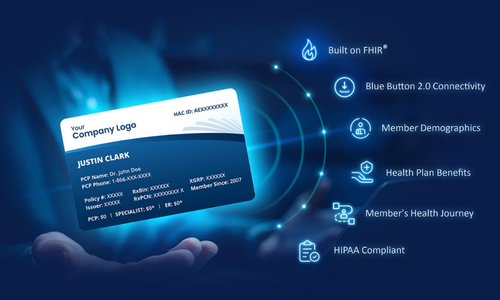
The Health Access Card represents part of that broader vision. A simpler, more portable way to connect healthcare information and make it available when and where it is needed.
Watching attendees stop, laugh, compete, and then transition into serious conversations about interoperability may have been one of my favorite moments of the entire conference.
Why These Conversations Matter
Healthcare is often described as a technology industry, a policy industry, or a reimbursement industry. In reality, it is still fundamentally a people industry. Technology platforms will continue to evolve. Regulations will continue to change. Payment models will continue to mature. But meaningful progress almost always begins when people are willing to share experiences, challenge assumptions, and learn from one another.
You could feel that spirit everywhere throughout TXAACOs. It showed up in formal sessions, candid hallway discussions, dinner conversations, and collaborative problem-solving among organizations facing many of the same challenges. Those interactions create something far more valuable than a collection of conference notes. They create relationships, trust, and the exchange of practical knowledge that ultimately influences how care is delivered. For organizations navigating the continued evolution of value-based care, that spirit of collaboration may be one of the most important assets available.
Long after the slides are forgotten, the relationships and conversations are what continue moving the work forward.